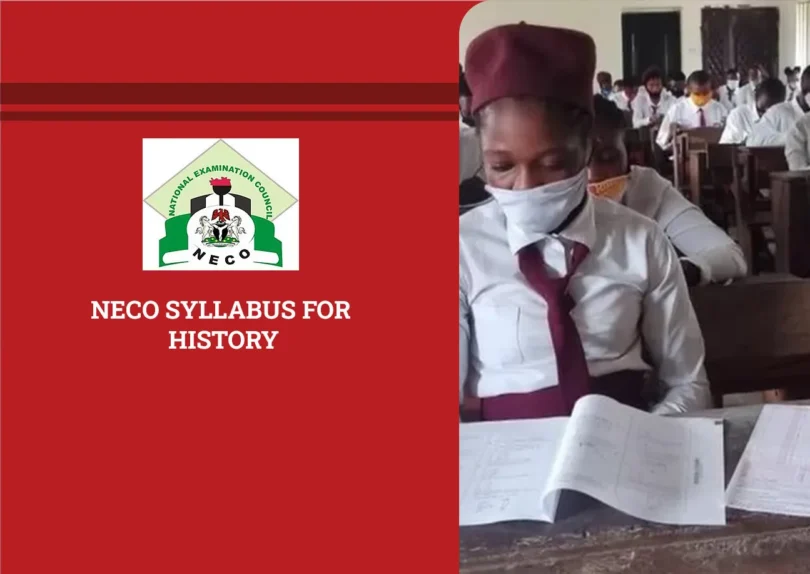
The National Examinations Council (NECO) has released the official syllabus for all candidates preparing for the 2026/2027 History examination. Candidates who will be sitting for the examination are advised to study the syllabus carefully because it contains the important topics and areas NECO expects students to cover before the exam.
The syllabus serves as a guide for examination preparation, helping candidates understand the topics they need to focus on while reading. Using the syllabus can also help students prepare in a more organized way and avoid spending time on irrelevant topics.
In this article, you will find the complete NECO syllabus for History, including the examination scheme and the major topics candidates are expected to study before the examination.
NECO History Examination Scheme
The NECO History examination is divided into two papers, and candidates are expected to take both papers in one sitting.
Paper 1
This paper is the objective section and will contain 50 multiple-choice questions. Candidates are expected to answer all the questions within 1 hour. The paper carries 40 marks.
Paper 2
Paper 2 is the essay section and will last for 2 hours. The questions will be grouped into three sections:
- Section A: Nigeria from the earliest times to 1800
- Section B: Nigeria in the 19th century
- Section C: Nigeria from 1900 to 2000
Each section will contain several questions, and candidates are required to answer four questions in total, choosing at least one question from each section. This paper carries 60 marks.
NECO Syllabus for History 2026/2027
PAPER 1: West Africa and the Wider World From Earliest Times to 2000
| S/N | Topic | Areas to Study |
|---|---|---|
| 1 | Historiography and Historical Skills | Meaning of History, reasons for studying History, sources of History, historical skills, ICT in historical studies |
| 2 | Trans-Saharan Trade | Origin, organization, and effects on West African states |
| 3 | Islam in West Africa | Introduction, spread, and effects of Islam |
| 4 | European Contact with West Africa | Reasons for European contact, immediate effects, and African reactions |
| 5 | Trans-Atlantic Slave Trade | Origin, organization, effects, and suppression |
| 6 | Christian Missionary Activities in West Africa | Suppression of the slave trade, missionary activities, and their impact |
| 7 | Scramble and Partition of West Africa | Industrial Revolution, colonial conquest, occupation, and African resistance |
| 8 | Colonial Rule in West Africa | Colonial administration, colonial economy, social changes, and World Wars |
| 9 | Problems of Independent West African States | Neo-colonialism, economic problems, military rule, instability, and boundary disputes |
| 10 | West Africa and International Organizations | United Nations, African Union, ECOWAS, aims, achievements, and challenges |
PAPER 2: Nigeria From Earliest Times to 2000
Section A: Nigeria From Earliest Times to 1800
| S/N | Topic | Areas to Study |
|---|---|---|
| 1 | Historiography and Historical Skills | Meaning of History, sources of History, historical methods, ICT in historical studies |
| 2 | Land and Peoples of Nigeria | Geographical zones and their effects on human activities |
| 3 | Centers of Ancient Civilization | Nok, Ife, Igbo-Ukwu, and Benin civilizations |
| 4 | Centralized and Non-Centralized States | Kanem-Borno, Hausa, Nupe, Oyo, Benin, Igbo, Efik, Tiv |
| 5 | Indigenous Crafts and Industries | Pottery, salt making, weaving, carving, bronze casting, boat building, leather works |
| 6 | External Influences | Trans-Saharan trade, Islam, European contact, Christianity, and their impacts |
| 7 | Nigeria and the Trans-Atlantic Slave Trade | Origin, organization, and effects |
Section B: Nigeria in the 19th Century
| S/N | Topic | Areas to Study |
|---|---|---|
| 8 | Sokoto Caliphate | Establishment, administration, and impact of the Sokoto Jihad |
| 9 | Borno Under the Shehus | Rise of El-Kanemi, development under the Shehus, and decline of Borno |
| 10 | Christian Missionary Activities | Activities and effects of missionaries in Nigeria |
| 11 | Yorubaland in the 19th Century | Ibadan dominance and British influence |
| 12 | Benin in the 19th Century | Political and social developments |
| 13 | British Conquest of Nigeria | First phase of British conquest from 1851 to 1900 |
Section C: Nigeria From 1900 to 2000
| S/N | Topic | Areas to Study |
|---|---|---|
| 14 | British Conquest and Colonial Rule | Amalgamation of 1914, indirect rule, colonial economy, and administration |
| 15 | Decolonization Process | Rise of nationalism, nationalist movements, and independence |
| 16 | Nigeria Since Independence | First Republic, military rule, civil war, Second Republic, Babangida regime, Abacha regime, and return to democracy |
| 17 | Nigeria and International Organizations | United Nations, Commonwealth, African Union, ECOWAS, OPEC |
| 18 | Global Issues | Racism, debt relief, peacekeeping, world peace, Millennium Development Goals |
Success Tips for NECO History
- The syllabus helps you understand the exact topics NECO focuses on, making your preparation more organized.
- Using both your class notes and recommended History textbooks will help you understand events better.
- Past questions will help you understand how NECO sets History questions and the topics that appear frequently.
- History involves important dates, personalities, wars, and political developments, so revise them regularly.
- Do not memorize blindly. Try to understand the causes, effects, and significance of historical events.
- A proper study timetable will help you cover all sections of the syllabus before the examination.
The NECO syllabus for History is an important guide for every student preparing for the examination. It outlines all the major topics candidates are expected to study and helps students focus on relevant areas during preparation.
Candidates should make sure they study all the topics carefully, practice past questions regularly, and revise consistently before the examination. You should also share this article with other students preparing for the NECO History. If you have any questions, you can ask in the comments section.


Leave a Comment